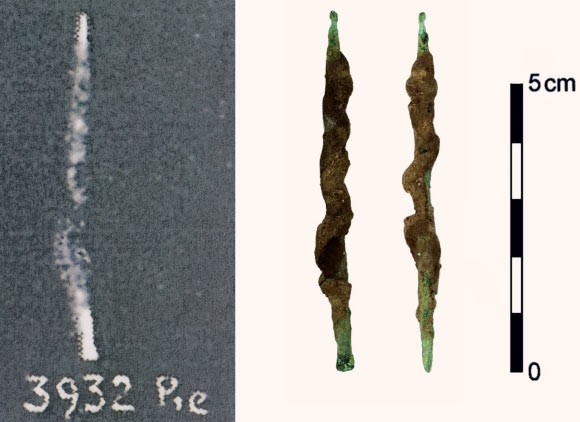
A tiny copper artifact, previously overlooked as a simple awl, has been definitively identified as the earliest known rotary metal drill from ancient Egypt. Dating back to the Predynastic period—around 3300 BCE—this discovery reshapes our understanding of early Egyptian technology. The tool, only 2.5 inches long and weighing less than half an ounce, was found at Badari in Upper Egypt.
Rediscovering a Lost Technology
For decades, the object languished in archaeological records, dismissed as insignificant. The original 1920s description labelled it merely a “little copper awl with leather thong.” However, recent analysis led by Dr. Martin Odler of Newcastle University and Dr. Jiří Kmošek of the Academy of Fine Arts Vienna reveals unmistakable evidence of its true purpose.
Microscopic wear patterns – including fine striations, rounded edges, and a slight curvature – confirm the drill was used in a rotary motion, not simple puncturing. Preserved fragments of leather thong suggest the tool was powered by a bow drill, a precursor to modern hand drills, using a bow to spin the drill rapidly. This method would have been far more efficient than manual twisting or pushing.
The Importance of Rotary Drilling
The re-identification is significant because rotary drilling was crucial for early Egyptian crafts. It allowed for precise work with wood, stone, and beads, enabling the creation of furniture, ornaments, and other essential items. This discovery pushes back the timeline for this technology by over two millennia, proving that Egyptian craftspeople mastered reliable rotary drilling long before other well-preserved toolsets emerged.
“The ancient Egyptians are famous for stone temples, painted tombs, and dazzling jewelry, but behind those achievements lay practical, everyday technologies that rarely survive in the archaeological record.” – Dr. Martin Odler
An Unusual Metal Composition
Chemical analysis using portable X-ray fluorescence (pXRF) reveals the drill wasn’t made from pure copper. Instead, it’s an alloy containing arsenic, nickel, lead, and silver. This composition would have resulted in a harder, more durable metal than standard copper, potentially achieved through deliberate alloying choices.
The presence of silver and lead raises questions about ancient trade routes. The researchers suggest this points to wider material networks connecting Egypt to the broader Eastern Mediterranean region as early as the 4th millennium BCE. This hints at a level of technological exchange previously underestimated for the period.
The research, published in Ägypten und Levante, demonstrates how seemingly unremarkable artifacts can rewrite our understanding of ancient innovation. This drill stands as a testament to the ingenuity of early Egyptians, revealing that their mastery of metalworking and engineering was far more advanced than previously believed.
This discovery underscores the importance of revisiting old data with new techniques – sometimes, the most groundbreaking finds are hidden in plain sight.