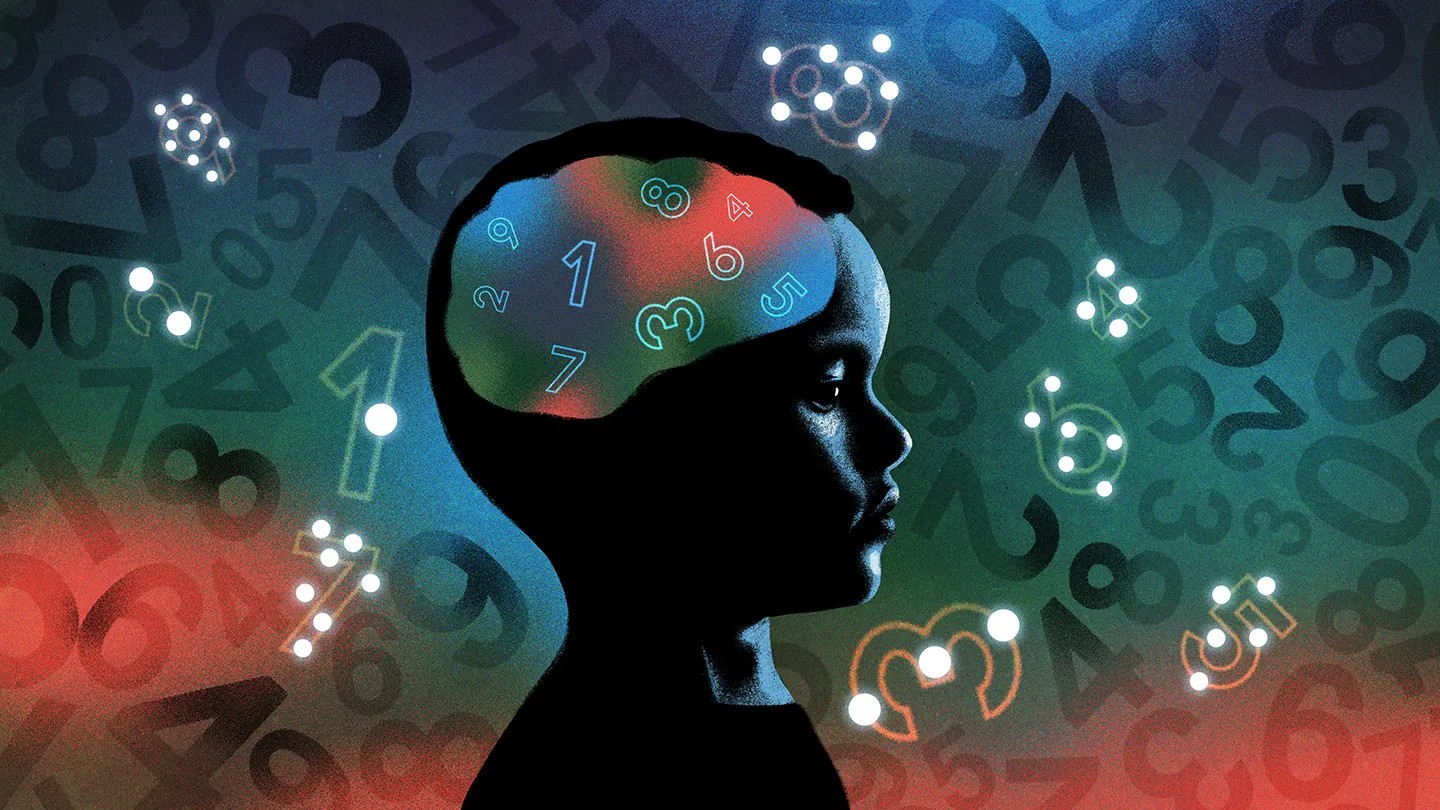
For educators and parents, the question of why some children grasp mathematics effortlessly while others struggle has long been a source of frustration and confusion. New research offers a nuanced answer, shifting the focus from raw intelligence to cognitive processing styles.
A study published in the Journal of Neuroscience reveals that children with math learning disabilities often approach numerical tasks with less caution and fail to adjust their behavior after making mistakes—but only when dealing with abstract number symbols. When the same children were presented with numbers as groups of dots, these behavioral and neurological differences vanished.
This finding suggests that the core challenge for many struggling students may not be an inability to understand quantity, but rather a specific difficulty in processing symbolic representations of numbers.
The Experiment: Symbols vs. Dots
Researchers from San José State University and Stanford University conducted a study involving second- and third-grade students. The participants were divided into two groups based on standardized test scores: those with typical math skills and those identified with a math learning disability.
The children were asked to compare pairs of numbers (from 1 to 9) while undergoing MRI brain scans. The study focused less on whether the answers were correct and more on how the children approached the task. Specifically, researchers measured:
* Response caution: How carefully the children considered their answers.
* Error monitoring: Whether they slowed down or adjusted their strategy after making a mistake.
In the first phase, using standard number symbols, children with math disabilities tended to rush their answers. Crucially, they did not exhibit the typical “pause and reflect” response after an error that their peers displayed.
However, in a second phase, the researchers replaced number symbols with dot patterns representing the same quantities. The results changed dramatically. The children with math disabilities no longer rushed; they answered with the same caution as their peers and appropriately slowed down after errors. Their brain activity patterns also normalized, showing no significant difference from the typical group.
What the Brain Scans Showed
The MRI data provided a biological explanation for these behavioral shifts. Two specific brain regions stood out during the symbolic number tasks:
- The Middle Frontal Gyrus: Associated with short-term memory and numerical thinking, this area showed reduced activity in children with math disabilities when they answered hastily.
- The Anterior Cingulate Cortex (ACC): This region is critical for error detection and monitoring performance. It was less active in the struggling group when they failed to pause after making a mistake.
When the task switched to dot patterns, activity in both regions became comparable between the two groups. This indicates that the neurological “glitch” is not a general deficit in math ability, but a specific hurdle in processing abstract symbols.
Why This Distinction Matters
The distinction between symbolic and non-symbolic number processing is significant for how we understand math learning disabilities.
“It’s the symbolic processing that is really the struggle,” says Bert De Smedt, a neuroscience researcher at Catholic University Leuven, who was not involved in the study.
De Smedt notes that while the difficulty with symbols is known, this study highlights the mechanism behind it. The struggle isn’t just about knowing that “5” is larger than “3”; it’s about the cognitive load and caution required to interpret the symbol itself. When that symbolic layer is removed, the underlying number sense remains intact.
Marie Arsalidou, a neuroscientist at York University, adds that this reinforces the idea that math is not handled by a single “math center” in the brain. Instead, it involves a network of regions, including those responsible for attention and error correction.
Implications for Education
These findings challenge the assumption that struggling math students simply need more practice with numbers. Instead, they suggest that metacognitive strategies —teaching students how to think about their thinking—could be more effective.
Hyesang Chang, the lead researcher, points to “hidden mechanisms” in problem-solving that impact performance. If the issue is a lack of caution and error monitoring specifically tied to symbols, interventions could focus on:
* Teaching students to explicitly check their work when dealing with numerals.
* Using concrete representations (like dots or objects) to build confidence before transitioning to abstract symbols.
* Training students to recognize when they are rushing and to engage their error-monitoring brain regions.
Conclusion
This study clarifies that for many children, math difficulties are not a blanket inability to understand quantities, but a specific challenge in processing abstract symbols with sufficient caution and error awareness. By identifying these hidden cognitive mechanisms, educators can move beyond rote repetition toward targeted strategies that help students navigate the symbolic demands of mathematics.